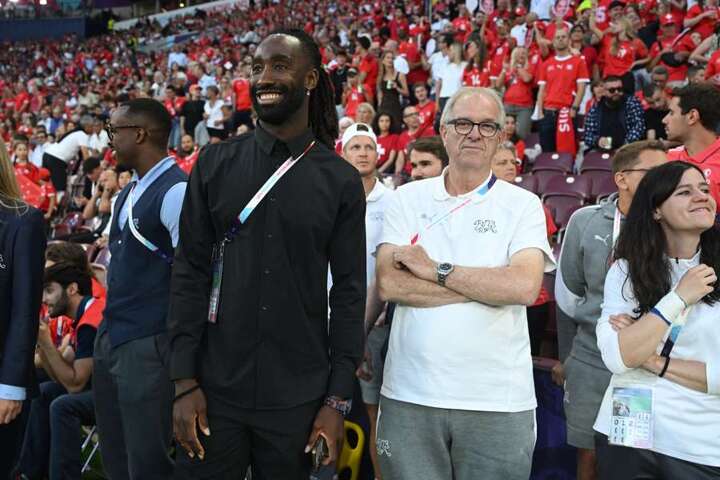
Johan Djourou, a former central defender at Arsenal and Hamburg, is now the head coach of the Swiss ladies' national team.
In an interview with FlashScore, he talks about the development of women's football in Switzerland and the promise of a successful European championship at home.
How are Swiss women's football?
“It doesn't do it too bad. If you look at the players playing abroad, who play for big clubs, I find it very interesting, such as Sydney Schertenleib or Lia Walti, or other players in Germany … We also have the export of Iman -Bene, who went to Manchester City, and Naomi Luyet, who is to Frankfurt.
But the Swiss women's competition is not professional, right?
“That is what is really missing today in Switzerland, this somewhat professional side, so that the players can concentrate more on football than at work outside the game. Unfortunately, what is a bit of a problem today, but it is also the case in other countries, that girls are not 100% on football, because they have to work on the side and do other things to make money.
Is it one of the plans of the federation that Swiss women's football should ever become professional?
“Of course there are ambitions. We still have a lot to do. We would like to see the number of registered players rise and have more young girls who sign up to play football. We are currently at 40,000 and we have to reach 80,000 after the euro.
We are already working on Grassroots football and training. And then of course we would like to become women's football in Switzerland, but we also know that unfortunately it is a matter of resources, TV rights and income. We have the will, but I think there is still a bit of work to do before we arrive there. “
Is there a strict plan to achieve this?
“We have set up a legacy program to leave a permanent, long-term effect after the euros. On the professional side we are a country that is incomparable with France or other countries where things are more professional. So today, Switzerland is progressing, Switzerland is learning and we can see that with the players we are training today.
“But it is complicated to get involved, seen where women's football starts. The girls don't even play in stadiums that have been approved all season. They still play in stadiums used by amateur clubs. So there is all that to try to have a much more professional side.
“To achieve a professional level, you need many skills”
Was there a wish at national level before Euro 2025 to accelerate things a bit, to ensure that Swiss women's football did a little better?
“There has always been a desire to improve, or at least try to learn from others. We know Denmark is working well, we know that Germany is working well, we know that France is working well … But then it is a matter of relationships, it is a matter of the number of players, it is a question of the number of people involved, because there are no people who are not needed.
So there are all kinds of aspects. But it is true that in the run -up to the euros, in particular one of my programs, the impulse program, was to do everything to optimize our performance in the euros, to optimize everything at the athletic and medical side at national team level, to try to compete with the largest teams. “
It has been said that Swiss women's football has taken a long way in the last ten years. What exactly has changed?
“I think it is partly the opening of boundaries by certain players, such as Lia Wälti who left, Geraldine reuter who plays in Frankfurt … so it's a bit like the boys, there is an experience that is gained abroad, there is a know -how that then also returns to the country.
The same applies to training, which is good today with the training center that we have in Biel, where the players are followed at a very young age, so that they have a clear path to follow when they are mentally strong. So there is a lot of work that has been done over the years, but it is also inspired by what we get from players playing abroad. “
“We must be determined to let young Swiss players play”
And will this work continue after the euros?
“Yes, it is of course part of our Legacy program. The Legacy program asks clubs to participate based on certain criteria or parameters that they can meet, after which they earn points and speed up their progress.
Our goal is also to optimize the training of coaches, the training of players and the skills of people who are also involved in women's football. It is really a program to also develop Grassroots football, because we know that as soon as the basic football is better, you end up with more players with an interesting potential for the future. “
And if we see that certain clubs, especially young boys, play the game in terms of training, is there a desire for a national urge for training in women's football?
We want as many Swiss players as possible in our competition. So you have to understand that at some point the Swiss championship is a springboard, a championship that offers training for other countries.
“And I think we are now slowly seeing that with the examples I have given: Iman Beny, Naomi Luyet and Noemi Ivelj, who are now leaving and show that the championship is of high quality. But it is true that we have to be determined to have young Swiss players play.
Have clubs been set up training centers?
Again, it's a matter of resources. There is the training center of the Federation and then there are the professional clubs, with facilities for under the age of 15 who play with the boys, but we don't really have training centers as such.
You say that the Swiss championship is a springboard. Is it still complicated to keep young talents such as Luyet or Beney in Switzerland?
Yes, clear. And then it is also a matter of sources. These young players want to earn a living and do nothing but play football. So today it is complicated to keep young talent long if you know that you earn much more money abroad and are a full -time professional.
“With what happens, people are aware of the potential”
Are you optimistic about the future of Swiss women's football if you see all the national enthusiasm for Euro 2025?
“It is very positive. I think people have also learned to consume the product and to appreciate it. Now it is up to us, the clubs and the football club to maintain it. Because we know that a euro is a flourishing. But then there is the excitement, passion and so on. And that is where we have to be good to achieve.”
If we take France as an example, the World Cup 2019 was not immediately followed by changes for French women's football …
“We are aware of it. That is why we have to find new formulas, be new ideas and be original. Ladies' football has many qualities that people appreciate, the euro is good, there are a number of great matches … There may also be a need to realize that yes, there are 30,000 people in the stadiums, but that some girls will play soon.
“It is a product that is flowering. We cannot expect 25,000 people tomorrow at every Swiss league match, after the euro. That would be unreal. We have to continue to build quietly and add one brick at the same time so that we can achieve something that lasts in the long term and in a few years.
Will this European Championship force the directors of the clubs and the Federation to make a larger report of women's football?
“Yes, of course it will. I don't think we can no longer hide. With what happens, people are aware of the potential. So it is up to us to think carefully about how we can continue to show and use this product to the best effect.
Did you expect such an enormous answer? Because there are cities nowadays where it is difficult to find a Swiss national teams of ladies …
“I expected this. I know the team and its quality. So yes, I know people also hesitate, but it is great that people finally accept and see the quality and beauty of this product. After that you naturally need results, you need performance.
And I think that as soon as the girls have put their shoulder on the wheel and people have realized that it is not a matter of boys or girls, that these are women who fight for their country, it is clear that the craze will be on Vanit. And it's great to see this national enthusiasm in competitions, with shirts everywhere, it's extraordinary. “
“Some players will continue to emphasize that we can always do better”
If someone who is constantly in contact with NATI, is it a subject in the dressing room to say that outside of this euro there is a desire to promote the Swiss championship to promote Swiss women's football?
“I think that has been everyone's struggle for a long time. If you look at Lia Wälti or the players who started long ago, when there was no one in the stadium, and today they play in full stadiums, in Arsenal or elsewhere, it is clear that they are prailbladen.
“So for them the message has always been the same, namely to have women's football accepted because of its qualities and its value, without hatred, just to have their place. I think they are very happy with what is happening and we want it to continue.
In the streets of Switzerland we see a lot of advertising with their faces. Does that make them more identifiable, but also more legitimate when it comes to defending women's football?
These girls have been identified. I think it is important to ensure that young players can identify with their heroines. That is what would happen to men, and it is completely normal that they have their place in marketing everywhere they go and everywhere in every city.
One last question about the Swiss team. As a head coach, are you optimistic about the match against Spain?
As far as the game is concerned, today is 50-50. We know they are one of the best teams in the world, but today it is 0-0. And it will also be 0-0 at the kick-off, so it is up to us to do all our ingredients, passion and determination to try to make an upset.
Switzerland vs Spain Pre-Match Infoflash score