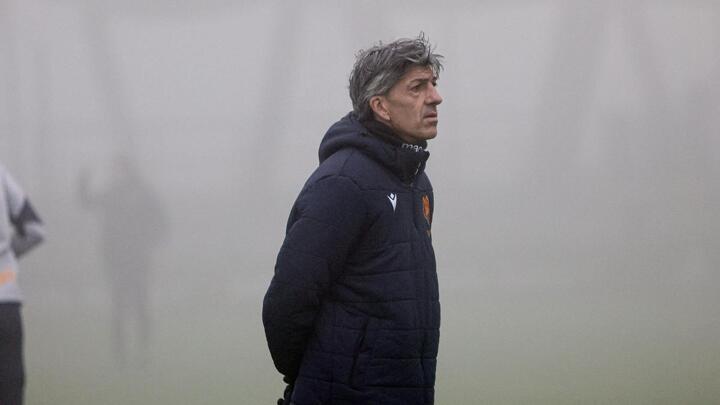
At the end of April, after a painful 1-0 defeat in Mendizorroza, what started as a standard debrief after the game an unexpected turn. Imanol Alguacil, the long -standing coach and compass of Real Sociedad, announced that he would not renew his contract. For many, the timing suddenly watched. Alguacil's restraint to renewing in the midst of the turbulent season of La Real, clearly showed that he had serious doubts, but only two weeks earlier suggested improvement in renewal interviews. Internally, the club believed that they were close to sealing another chapter with their most successful manager in recent history. Instead, they received closure.
Alguacil's decision was not powered by public fallouts or internal ultimatums. The relationship with sports director Roberto Olabe and the rest of club management had ups and downs over the years, but the club understood and respected the importance of Alguacil. The management was very willing to extend his contract.
However, it seems that Alguacil refused to renew because he could not fulfill the standard he set for himself. He explained this during the press conference where he announced his decision:
“I leave with sorrow and I wanted to renew, but I am ambitious and I wanted to win more. And even if we are eligible for Europe, which I really hope we do, it is not enough for me. And those are the reasons, so don't try to look for other reasons.”
When a coach who has been closely identified with a club, chooses to walk away, it is rarely a single bad season. It is usually about knowing when the cycle performed its course.
The appointment of Imanol Alguacil in March 2018 should not change the history of the club. He was a temporary patch, a trusted internal figure that was brought in to stabilize the ship after a rough spell. In December of that year he was appointed full -time coach after the resignation of Asier Garitano, and the rest is history. Six years later, Real Sociedad has again settled as a top-la league side of the top, qualified five times for Europe, a long-awaited Copa del Rey removed and developed a clear tactical identity, all under his watch. Alguacil leaves as the most influential real Sociedad coach of the 21st century, and one of their best coaches ever.
Although his team was initially seen as an attacking, possessed side, their success over the years made more control and compactness. They stinked opponents with off-ball structure, won second balls and delayed transitions with tactical errors.
More than any tactical wrinkle, however, the biggest impact of Alguacil was cultural and philosophical. He represented better than anyone else the club motto of “Ser Los Mejores de Lunes A Viernes”. Be the best in your process from Monday to Friday, and the results on the weekend will take care of MatchDay for itself.
Kieran Tierney, a man who grew up in an intense, stabbed football culture, was impressed when he arrived at the club and witnessed the intensity of the training of Real Sociedad, as he shared in an interview with the athletics:
“Nobody stopped, everyone came across challenges. There was no going on with 85 percent because a game is coming. People think of Spain and Tiki-Taka, but this group is about winning hard work.”
“The way they compete is incredible. It comes from the manager. Everything is about winning your duels. If you don't, you know.”
And this culture shift worked. La Real developed one of the most consistent cores of Spain with Martin Zubimendi, Mikel Merino, Robin Le Normand, Alex Remiro and Mikel Oyarzabal. The project also attracted and developed controversial attacking talent: the short but brilliant loan from Martin Odegaard, the graceful twilight years of David Silva, the electric development of Alexander Isak. Everything flourished in the Alguacil ecosystem.
After five seasons of consistency and top-six finishes, the cycle seems to reach its natural end point this season. The team is in eleventh place and the European qualification is still a possibility, but the versions are disappointing. The La Real season is determined by one striking shortage: goals.
Despite the departure of Le Normand, the defensive structure continues to work. Their XG admitted and the permitted goals remain close to last season's levels. In the front, however, they are the fifth-strict attack in the competition with 32 goals.
This decline stems from a steady erosion of attacking talent. In the past six years, players such as Merino, Odegaard, Isak and Sorloth have come and gone. Silva retired and injuries turned Oyarzabal into a different, less impactful player.
Their successors – Brais Mendez, Sergio Gomez, Luka Sucic, Arsen Zakharyan, other BarrenetXea, Sheraldo Becker and a carousel of inconsistent strikers – still have to reach a similar level. Every departure demolished at La Real's attacking bite, and this year they have reached a new low point. Takefusa Kubo has been the most consistent performer of the attack, but his output alone is not good enough to drag the team back to European position.
Faced with this talent drain, Alguacil has difficulty finding new solutions, and as the results slip, frustrations are mounted. After a painful loss in the Basque derby in November, he rumbled: “If I could have replaced all eleven players, I would have done so.” Captain Mikel Oyarzabal defended the players and shot back: “Maybe we should see how we set it up [the game]'A clear puncture with the tactics of Alguacil.
With both Imanol Alguacil and Sporting Director Roberto Olabe who is purchasing, it would be assumed that Real Sociedad is a big reboot. However, the club seems to be sufficiently trusting its process that its solution is easy to promote from within. Sergio Francisco, the current manager of the B team, is taking the reins of the first team this summer, while Erik Bretos, the head of Scouting, takes over the role of sports director. No drama, no searching and accepting outside the club.
Francisco has followed a similar path as Alguacil: a former player, old Zubieta insider and respected figure in the academy structure. He has worked closely with the current generation of young talent and understands the club's DNA. In that sense, the appointment suggests continuity instead of revolution.
However, it also invites skepticism. Francisco has never coached at the highest level of Spanish football. Thanks to the successes of the Alguacil era, the standards and expectations are much higher than when Alguacil took over in 2018. The expectation is that this team must be rebuilt while he remains competitive in the upper half of the competition.
You could also think that this agreement is a way to lower internal expectations. Perhaps this is the way of the club to tell fans to dampen their expectations. That the glory years of weekly European nights can take a back seat for development and stability.
However, I believe that the trust of the club in their internal process is just that strong. The club believes that betting on continuity and fame is the right gamble, even if it entails some risks. This time there is no surprise element like there was in 2018, and the expectations are higher.
Still, if there is one thing that La Real has taught us under Alguacil, it is that with a disciplined and clear process that has been applied consistently from Monday to Friday, the results will come. Now it's Sergio Francisco's turn to prove it.
José C. Pérez can be found here on social media, and if you are hungry for more, look for their excellent work here.