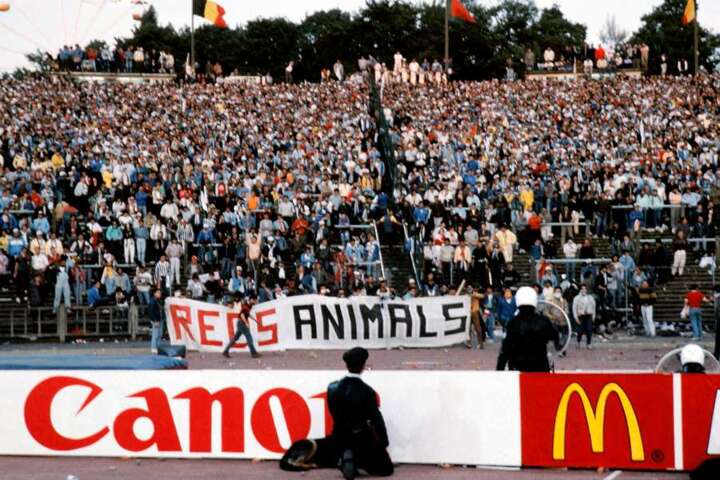
It is the week of major European finals. Last week Tottenham won the Europa League and defeated Manchester United in the final. Today (Wednesday 28 May), Chelsea and Real Betis will compete for the title of the Conference League. Finally, the most prestigious competition, the Champions League, will culminate on Saturday, when Paris Saint-Germain and Inter will face each other in Munich. All these finals are a celebration of football, but in Brussels in 1985 one of them ended in a huge catastrophe: the disaster of the Heysel Stadium.
On Wednesday evening of 29 May 1985, the football world was full of excitement and great expectation. Fans eagerly anticipated the battle for the coveted 'Eared Trophy', awarded to the winner of the European Cup – today known as the Champions League. Liverpool wanted to defend their victory by the previous year and win their fifth European cup, while Juventus wanted to make up for their loss in the last two years earlier when they were beaten by Hamburg with 1-0.
Millions of fans entered into their televisions to watch this football gala, but instead of seeing Star footballers preparing to kick off the biggest match of the season, they watched how rescue workers and bloody fans ran around the field.
They also saw different immobile bodies in the stands. About an hour before the planned start of the competition, a disaster had hit the outdated Heysel Stadium in Brussels.
Heysel Stadium@Oldschoolpanini X Account
Chaos, crowd of pressure and a collapsed wall
After the experience of the tense final of the previous year between Liverpool and Roma, the organizers approached the 1985 final with special caution.
The two groups of fans, where collisions were really expected, were divided in such a way that the sector behind one goal was exclusively dressed as fans dressed in the Red Liverpool, and the other for fans in the black and white of Juventus. The most important, longitudinal grandstands were occupied by more peaceful spectators.
A few dozen Juventus fans, however, managed to get into one of the neutral sections, near the Liverpool area. They had bought tickets on the black market. They were usually “normal” fans, with the hardcore supporters on the other side, but Liverpool -ultras didn't care.
The English hooligans broke through the barrier between the sectors and started attacking the Italian fans. Juventus' supporters wanted to escape the violence and push it to the exit – there was only one for a huge sector. Aggressive Reds fans pushed the retreating crowd for them, and the wall that separated the standard from the playing field could not resist the pressure of the masses of people who collapsed.
Many lives were lost in his ruins, with others also trampled through the crowd. Among the victims were more than thirty Italians, as well as different Belgians. The incident claimed 39 lives and around 600 people were injured.
The Juventus fans of the opposite stand were immediately hungry for revenge, but luckily the police still prevented a collision.
To play or not play
In the meantime, a heated discussion took place in the entrails of the stadium about what would happen to the competition.
It should of course have been canceled, but there was a high risk that there would be a massacre between the fans of the sides outside the stadium in the streets of Brussels.
The players of both teams initially refused to play, but were eventually convinced by UEFA officials.
The competition took place in a very gloomy, sad atmosphere. It was viewed by half a empty stadium, while some fans were looking for Brussels hospitals looking for their friends. The only goal of the game was a penalty in the 56th minute by Michel Platini.
Juventus symbolically devoted their first triumph in the most prestigious club match to the victims of the Brussels massacre.
Consequences of the massacre
The tragedy also had consequences for the field.
UEFA identified Liverpool fans as the most important culprits of the incident. Several of them went to court, convicted of 14 of them, and all English football clubs were banned from European matches. The ban lasted five years, and in the case of Liverpool, six (originally 10, but the sentence was later reduced). The Heysel Stadium disaster therefore had a far -reaching impact on all of English football.
The incident has also contributed to an important reform of stadiums and safety measures throughout Europe, with the emphasis on separation of fan, ticket control, CCTV, a ban on alcohol and seats instead of stadiums.